
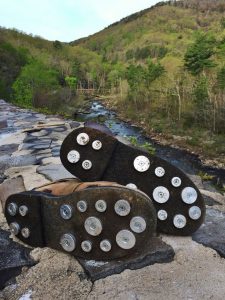
My grace on the river bed is like an elephant on skates. Time and time again, even with staff in hand, I tended to find the bottom on a days trek and typically more than once! Then in a Gink and Gasoline article I saw these unusual looking aluminum discs attached to a set of wading boots and thought what if? After diving deeper… no pun intended… I thought what the heck, let’s see how these work. Worse case I ruin my wading boots and gosh I’d just have to get a new pair.
I was heading to the water in just a few days and after finding a retailer fairly close by… Virginia… I swiped the PayPal and my new set of Rock Treads were on the way. Ironically my package got here faster from Virginia via USPS versus some of my Big T fly tying orders from across the county. Not sure why USPS struggles sometimes traveling 14 miles versus 500 miles, but hey, they usually do a pretty good job.
Anyway, upon arrival I started laying out the contents of the box in my methodical, follow directions way I do things, and watched a few videos to get an idea of what I was doing. Just a little background… I have Orvis boots with the BOA system and absolutely love these boots! I switched a few years back from felt to rubber primarily because of the amount of blue lining I do and needed a little more traction to traverse the gorges, trails and water falls in the back country. My studs I used were the Orvis titanium studs and they work pretty good.
With my new Rock Treads laid out on the coffee table and my cordless drill loaded with the provided drill bit, I proceeded to spend the bulk of my time anal-lyzing my layout, meaning I spent way too much time over thinking the pattern I wanted to use on the bottom of my boots. One challenge I found with the Orvis boots and the stud pattern system Orvis uses, it didn’t provide me with a simple existing hole pattern to follow; again that’s on me, not Orvis or anything else. Once I got my layout figured out I used a silver sharpie to color where I wanted to drill and started drilling. Forgot to mention, most wading boots allow you to remove the insole… however, I think I’ve seen where Simms might not, so check out YouTube and Rock Treads for more information. Also of special note, Rock Treads has https://www.rocktreads.com/installation/ a lot of useful information on installation.
Drilling was super simple and took no time at all. I then swapped out my drill bit for a phillips bit and selected the correct length of bolt provided, reached into the inside of the boot with the lock down nut, dropped the lock down nut into the sole, then from the bottom side of the boot found the lock down nut with the tip of the bolt and zip-zip first disc installed. I did go ahead and use heavy duty Loctite on my screw threads to help keep things secure. Rinse and repeat for both boots and within an hour had my new traction control system in place. On the picture below you’ll see I did use a couple of the Orvis titanium studs in the arch of the boot just to help, but I’ve found they really aren’t necessary.
The outcome has been nothing but amazing for me. In fact, I’ve found I don’t use my wading staff as much because the traction is so much better and even though you can still get some slippage, the discs work extra hard to grab when the river bottom looks in site. However, I still like my staff in hand as an extra protection mechanism, but I haven’t planted it since I’ve installed my Rock Treads back in February.
One special note: my first outing, which was up on the Davidson, I did notice a little soreness with my feet after a few hours. To fix this problem, I removed my insoles included with my Orvis boots and replaced them with Dr. Scholl’s Heavy Duty insoles and I haven’t looked back since!
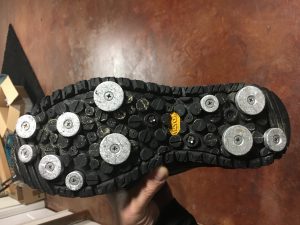
Are these for everyone… absolutely not. The purpose here is to highlight there are some cool and unique choices with your existing boots to aid in better traction and less time on the old buttocks. Also, if you just absolutely love your wading boots and don’t want to dish out the cash for a new set of Patagonia, Simms or Korkers that use the aluminum technology, then you now have a choice. The other purpose here is to point out how awesome aluminum is on rock structures and how quiet they are in the water.
I know in talking to Jimmy Harris at Unicoi Outfitters they’ve carried these in the past and may still do so. Also, it seems I may have seen these at Alpharetta Outfitters. But today I was buying some fly tying materials and noticed Big T now carries them too https://bigtflyfishing.com/collections/apparel-packs-and-bags/products/rock-treads-traction-kit?variant=14821800116287 so it looks like you don’t have to do what I did and waste time getting your new set of wheels.
I hope this helps you stay confident on the water as it has me and keeps the cold water out of your skivvies.
Chris Sloan